A Family Tie Is Like a Tree
Demetri Broxton: Ancestral Echoes
View Exhibition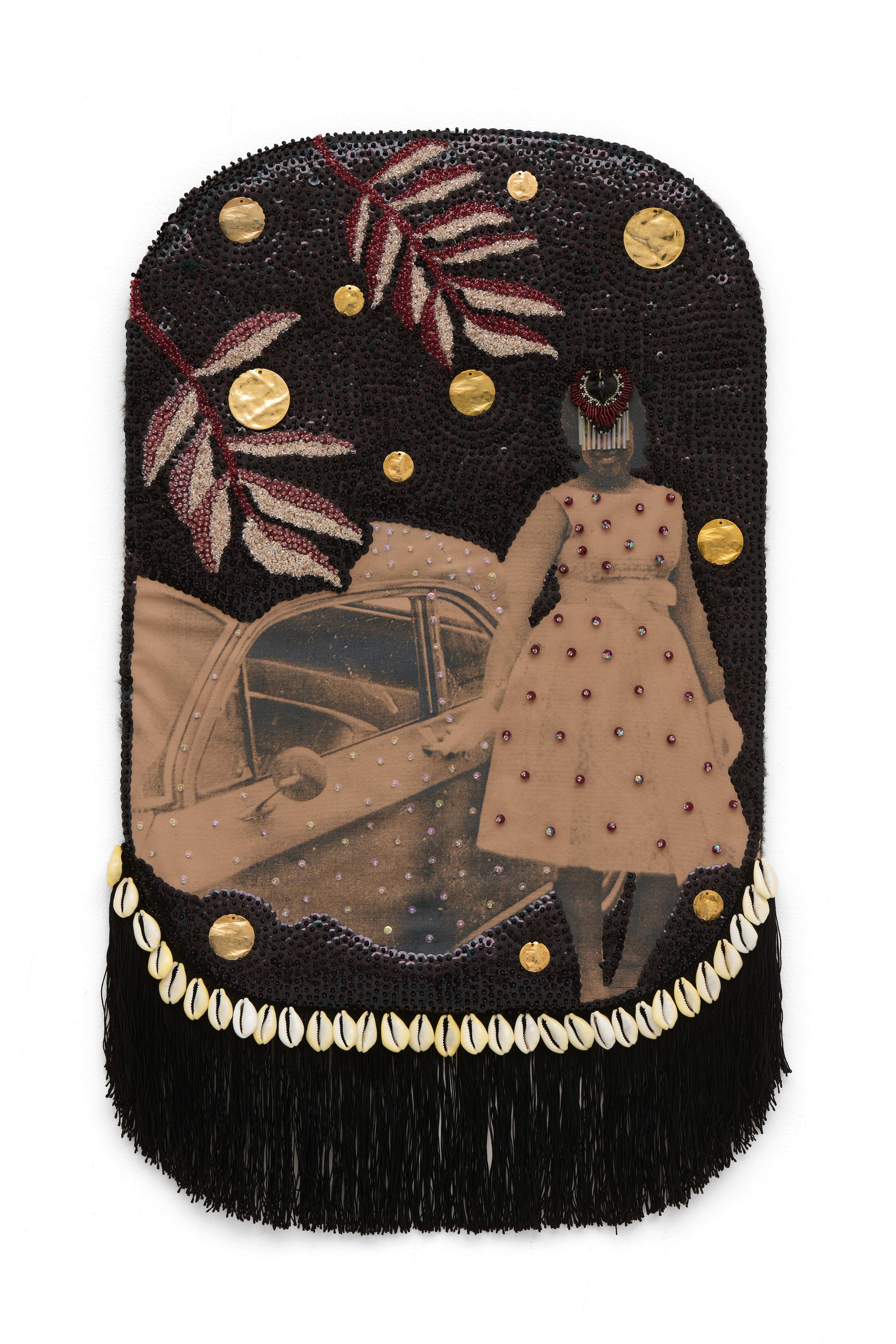
As someone interested in textile works, crafts, and old photographs, my connection to the pieces in Demetri Broxton: Ancestral Echoes were almost natural and automatic. The shining beads and metal drew my eye in and looking at these old photographs, memories of my own family started to surface and suddenly I couldn’t look away. Broxton is part of the Emerging Artists Program and his exhibition Ancestral Echoes explores the memory of our ancestors, how we keep them alive and carry them forward. Broxton works in a multimedia format, combining archival images with traditional African materials that connect him to his heritage. These pieces, intricate and lively, urge viewers to think beyond themselves, acknowledging and, most importantly, honoring the ancestors we come from.
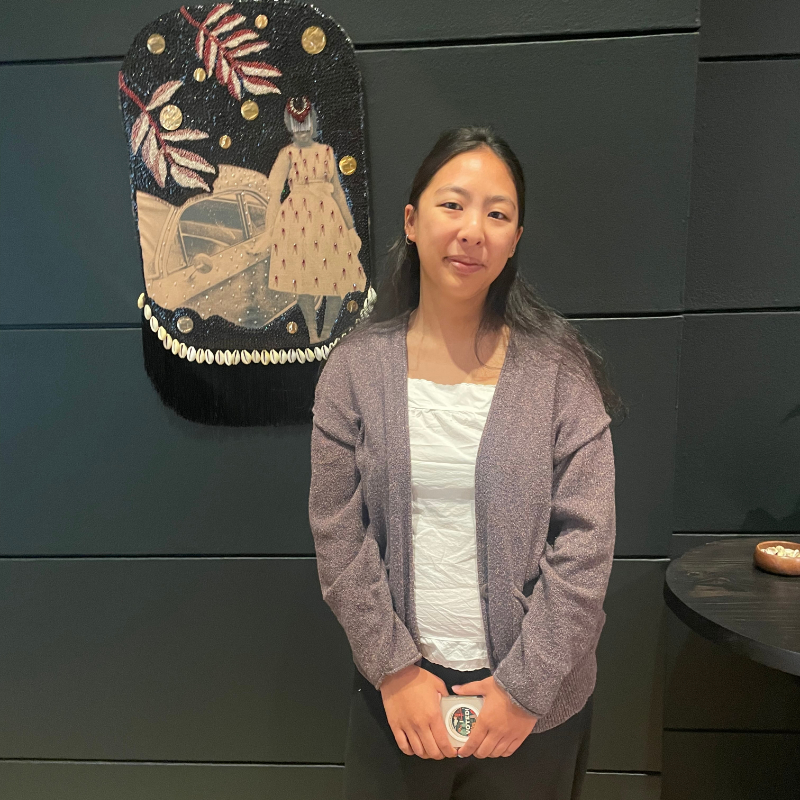
In A Family Tie is like a Tree; It can Bend but it Cannot Break, the woman photographed stands in front of a car wearing a dress and gloves. Photographs used to be a way to document the most special of occasions; the woman here preserves memory of her finest outfit, yet her destination remains unknown. While these photos are at the center of his works, Broxton views these images beyond their material exterior. He reveals that there is something deeper and underlying hidden within each picture taken, that they can represent “memories, futures, and hopes and dreams.”¹ We see what this woman looked like in her best dress, yet we know there is more to her story. The photo is a tool to help us imagine who she was, giving a window into both her personality and experiences. Broxton reimagines this historical photo through an Afrofuturist lens, deliberately removing and detaching the figure from her setting. With an ambiguous, open background, this woman can now come from any place or time; she is unbound from the real constraints and struggles of when she lived. She now exists in this space where all her dreams and desires of what she wanted to do, or who she wanted to be, are possible.
Within this work, there is a strong connection between old and new. While the images evoke a distant history, Broxton infuses them with new life, adding shining beads and sequins or dangling fringe. Each new adornment and material becomes a way to honor these ancestors, putting the work of the present into the memory of the past.
The background is made up of black colored sequins and beads, which can evoke the sense of a void or hole. The deep coloring sucks the viewer into a space that is both nothingness and limitless. Their life now exists in this space of both endless possibility and unrealized dreams. These black colored sequins, when taken apart, contain a silver layer and a transparent gray layer. No true black makes up the material, representing how their Black experience is always something layered and complex that lives outside the imposed box of blackness.²
Broxton also uses other significant materials such as cowrie shells, beads, and metal, all of which have ties to traditional African art, culture, and environment. Shells in African culture signify wealth, riches, and abundance. They were used as adornment and worn by women signaling their fertility and femininity, and also utilized in divination practices. In the eighteenth and nineteenth centuries, cowrie shells became currency, used during the slave trade when bodies were being bought and sold for these shells.³ The shells bring forth the dark history of the African diaspora while also serving as reminders of the land and environment from which they came. Holding forth these two realities, it reminds us how the Black experience is not just defined by trauma but also by the rich culture and traditions they were forced to leave behind.
Broxton was originally trained as a fine painter, but tracing the lineage of that art form always leads back to one rooted in European traditions. Textile and beadwork have been used across cultures and communities for centuries as a vernacular art form by and for everyday people. The work is tangible; hands actively engage and touch the materials, creating a level of intimacy that is not transferable to canvas and brush. The repetitive nature of stitching and beading leads to a meditative state which unlocks a sense of awareness and connection to one's humanity, heartbeat, and spirit.⁴
Stepping into the exhibition space, there is an overwhelming sense of nostalgia created by the sepia tone of each vintage photograph. I was reminded of my own family photographs and the time I have spent flipping through old albums. There were those I could vaguely recognize and others I couldn't. Sometimes they stood in places I go today, and I would imagine what brought them there and the thoughts that led up to that moment. Thinking about family draws on something deeply emotional. It forces you to acknowledge where you come from and the hardships your ancestors went through for you to be alive. It reminds me of my grandfather, great-grandparents, and even great-great-grandparents. Many of them I did not get to meet, but their presence lives on, not just in the photographs that I’ve spent hours examining, but in the people I love: the ones who raised me and who are still standing, who remind me never to forget the ones who aren't.
Photographs are insights into past people, but they can never tell the full story. They capture the real world in a way that forces you to confront your own reality, ultimately recognizing how the past and present are not far apart. Knowing the history or context of those who came before us can never tell you who they fully were but it can offer a point of connection and deeper insight into one's life and lineage. No matter what your individual path looks like or how far you stray, the connection to your ancestors will always remain; it is just about how you choose to honor them.
Citations
¹PhotoWings. “2026 CatchLight Visual Storytelling Summit: Demetri Broxton.” YouTube, May 22, 2026. https://www.youtube.com/watch?v=XneyeQ8ezmo.
²Broxton, Demetri (@demetribroxton). “I had to turn this story into a post. My recent work is focused on all "black" as the primary color field in which the figures reside.” Instagram, May 24, 2026. https://www.instagram.com/p/DYvGd4lkhaS/?utm_source=ig_web_copy_link&igsh=NTc4MTIwNjQ2YQ==
³Babalola, Abidemi Babatunde and Boluwaji David Ajayi. , “Of Glass, Stone, Shell, and Metal: Ecologies of Beads in Medieval and Post-Medieval West Africa,” Postmedieval 13, no. 1-2 (2022): 197-221, doi:https://doi.org/10.1057/s41280-022-00231-5.
⁴Broxton, Demetri (@demetribroxton). “I had to turn this story into a post. My recent work is focused on all "black" as the primary color field in which the figures reside.” Instagram, May 24, 2026. https://www.instagram.com/p/DYvGd4lkhaS/?utm_source=ig_web_copy_link&igsh=NTc4MTIwNjQ2YQ==.
Author