Creation Story
UNBOUND: Art, Blackness & the Universe
View Exhibition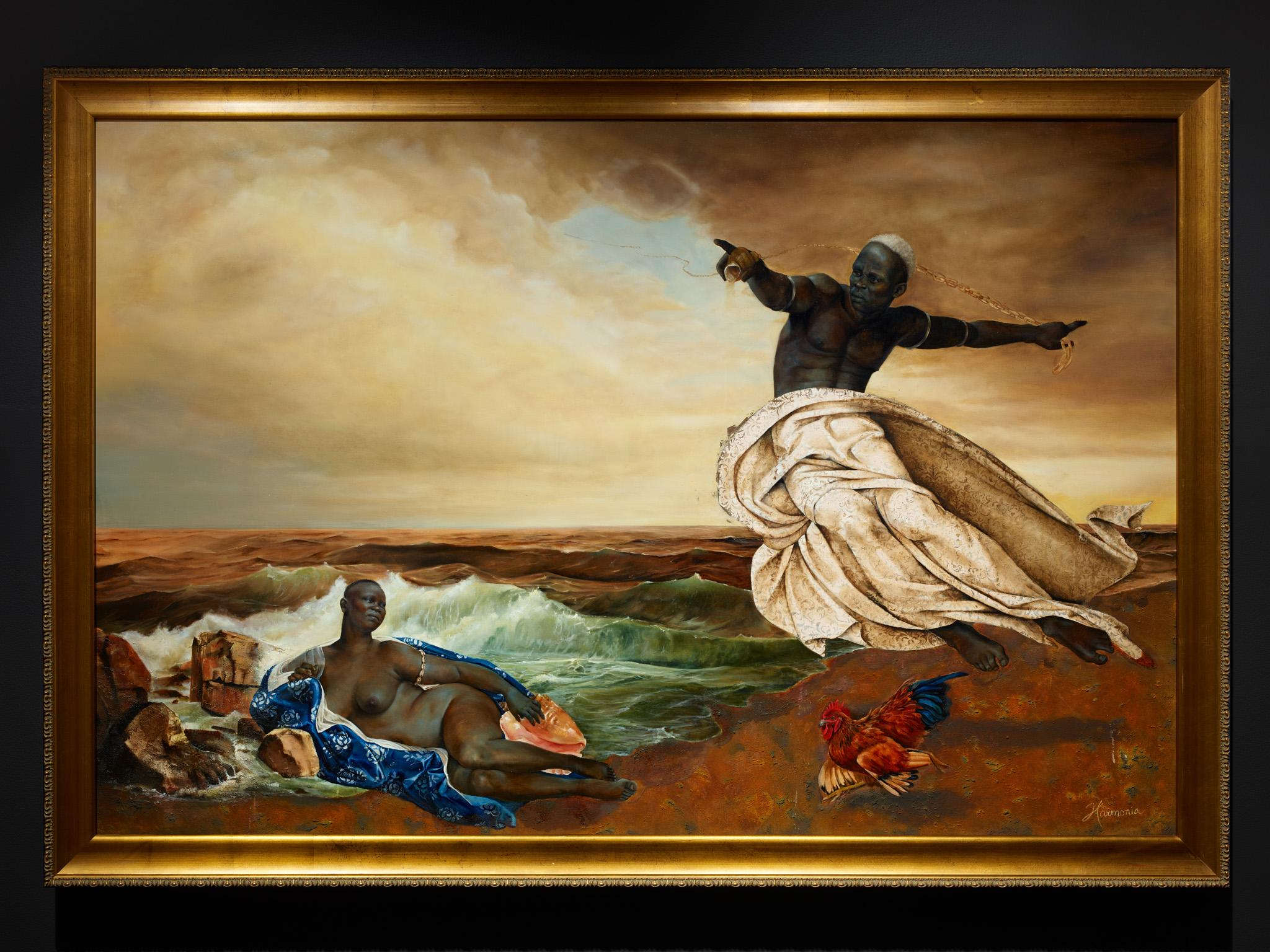
UNBOUND: Art, Blackness & the Universe takes up all three floors of MoAD, and you feel that scale before you fully understand it. Curated by Key Jo Lee and timed to the museum's twentieth anniversary, the exhibition gathers work by an international, multigenerational group of African diasporic artists, moving through Afrofuturism, origin stories, spirituality, and astrophysics. Lee's framing is that Blackness is not fixed or earthbound but infinite, expansive, and cosmically rich, and that it deserves the same intellectual openness we bring to the cosmos itself. Wall texts punctuate the galleries, leaving you with questions rather than answers, which sets the pace for how you move through the show. The walls are painted in deep blues and purples and the lighting is kept low and close, so the whole floor feels submerged before you have looked at a single work.
The first thing I noticed in Harmonia Rosales's Creation Story (2021) was the gold crown molding border, which felt less like decoration and more like a sacred threshold. It frames the work with the kind of reverence that asks you to slow down and step closer. Inside that border, the composition unfolds with two central figures that hold the entire atmosphere in balance. Obatalá, draped in white, descends with a gold chain and sand, while Yemayá, wrapped in blue, rests in the water below, surrounded by swelling clouds. Both are orisha, the deities of the Yoruba religion of West Africa and of the diasporic traditions that carried it across the Atlantic. The visual language feels both intimate and monumental, as if the painting is inviting the viewer into a cosmology rather than simply presenting an image. I experienced it not as a distant artwork, but as a living scene of origin, beauty, and divine memory.
What Rosales does in Creation Story is deeply intentional and historically urgent. She works in oil and genuine silver leaf on wood panel, with classical Renaissance precision, employing techniques that recall the polished surfaces, balanced composition, and idealized forms of European masterworks. The silver leaf matters as much as the brushwork. Metal leaf belongs to the devotional tradition of icons and altarpieces, where a reflective ground is a signal that what you are looking at is holy. Rather than reproducing the canon as it was handed down, she intervenes and disrupts the hegemonic narrative. Her work echoes the pose and symbolic structure of Michelangelo's Creation of Adam, yet she reimagines that visual through Black divinity and West African Yoruba cosmology. I don't see it as an imitation, but as a revision. It is art history rewritten from the inside. Rosales subverts Eurocentric religious imagery and challenges us to question how narrow that imagery has always been. For centuries, Western art has centered white masculinity as the default image of power, holiness, and creation. Rosales disrupts that inheritance by placing Black figures and orisha at the center of sacred narrative. Obatalá, in Yoruba spirituality, is associated with wisdom, clarity, and the creation of land. The white garments suggest purity, spiritual authority, and the beginning of form itself. Yemayá, the divine mother and force of the oceans, represents nourishment, depth, and life-giving abundance. Her blue drapery and watery setting evoke the ocean as both a literal and metaphysical source of existence. Together, they are not just beautifully rendered bodies. They are theological statements. Rosales gives visual form to spiritual knowledge that has often been ignored, distorted, or excluded from mainstream institutions.
As a USF student studying Advertising and Public Relations, I can't separate my response to this work from the way I think about visual storytelling and personal branding. Rosales is, in a very real sense, branding Black divinity. She creates a visual language that communicates authority, peace, and sacred value without needing a single line of text. The image does the work immediately. The colors, posture, composition, and symbolism all function like a carefully built brand that is emotionally resonant and culturally specific. I have always loved curation, photography, and the little details that build an archive of feeling: the angle of a photo, the palette of an image, the way an object can hold memory. For me, aesthetics are never just surface-level. They are a form of communication, a way of deciding what deserves to be preserved and what kind of world we want to imagine. Rosales understands that deeply. She uses the authority of classical technique to elevate Blackness into a visual register that is impossible to ignore. In that sense, her work proves that representation is not only about visibility, but about how a culture is framed, valued, and remembered.
What struck me personally was the rarity of seeing Black skin and Black bodies rendered with divinity and reverence inside a mainstream artistic space. So often, Western art history has positioned Black people at the margins: as laborers, servants, objects of spectacle, or symbols of trauma. Even when Black figures appear, they are frequently made to carry someone else's narrative. In Creation Story, that dynamic is reversed. Blackness is not supplementary. It is not decorative. It is origin. Rosales's choice to work in a Renaissance style is especially radical because she reclaims the very visual vocabulary that once excluded us. The painting speaks the language of the canon, but it refuses the canon's archaic assumptions. It is both familiar and revolutionary. It reminds me that representation is not just about seeing yourself reflected. It is about witnessing yourself in a space that once denied you access. In that way, this painting felt like a personal journal entry in visual form, one that I could read with my own history, my own hopes, and my own desire to be seen fully.
Returning to the frame the exhibition sets, Creation Story is where UNBOUND's central claim becomes something you can stand in front of. If the show argues that Blackness is infinite, untethered, and expansive, this painting embodies it. Rosales does not present Blackness as something bound to suffering or defined by whiteness. Instead, she places it within creation itself, among clouds, water, sand, and sacred lineage. Blackness becomes celestial, elemental, and uncontainable.
For MoAD, featuring this work is a message to the young Black people of San Francisco, including students like me, that our identities are not confined by the narratives we inherited. We can be spiritual, intellectual, artistic, and expansive all at once. We can create from memory and from possibility. Seeing this work publicly affirmed in a museum space helps make that feeling accessible beyond the gallery walls. It tells us that being unbound is not an abstract idea. It is a lived practice of reclaiming space, language, and image. For me, Creation Story is a reminder that art can hold theology, history, and self-recognition at the same time. It is a reminder that Black divinity belongs in the center, because when Black artists imagine us as sacred, the image itself becomes a form of liberation.
Citations
Author