Dark Shores
UNBOUND: Art, Blackness & the Universe
View Exhibition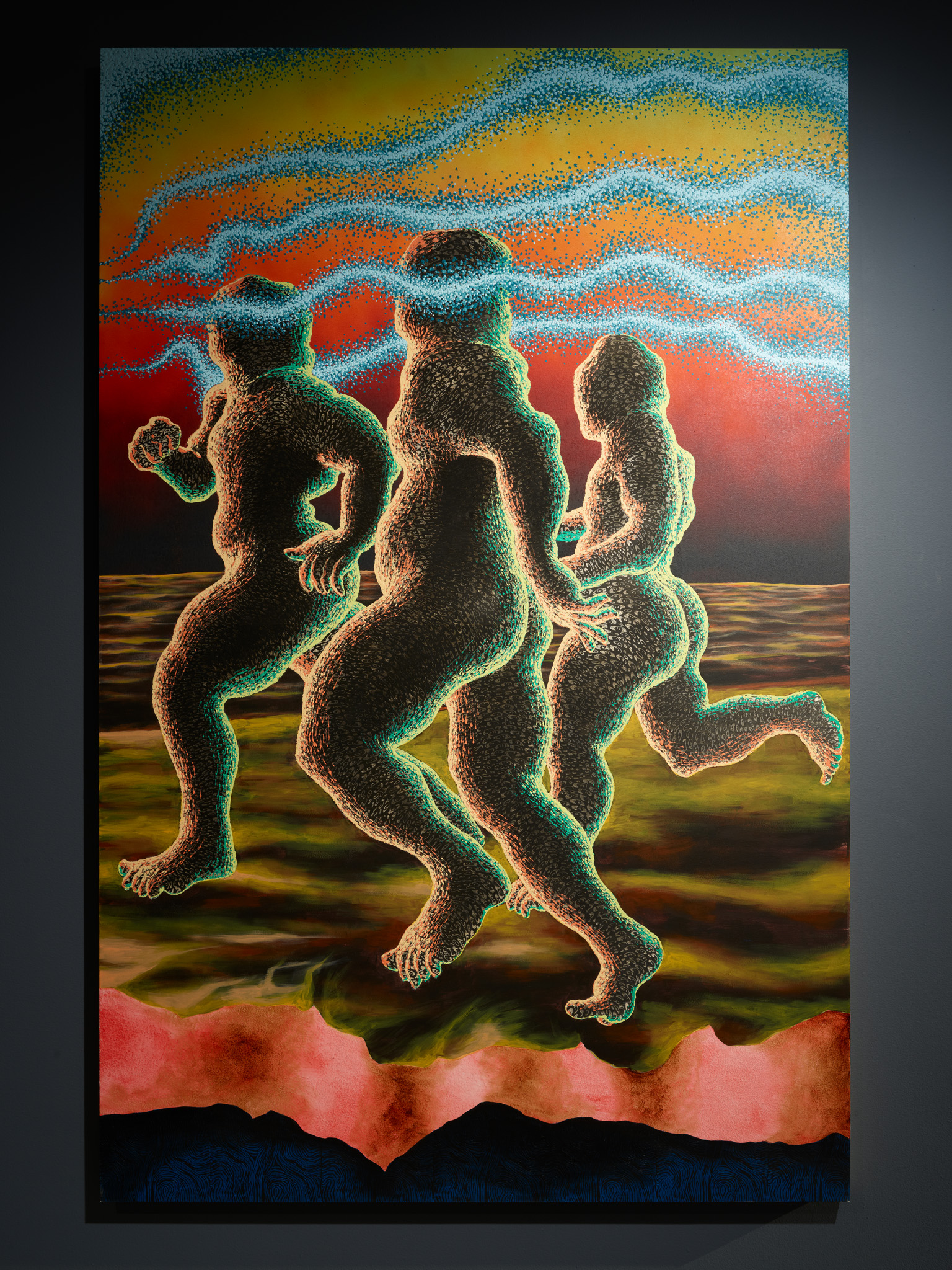
Color is the first thing Didier William's Dark Shores (2024) gives you, before it gives you anything else to hold onto. The panel is nearly seven feet tall and sits in a corner of the gallery where the walls run gray. It burns against them. Everything in the work is red, orange, yellow, green and black, overall colorful, so it reads hot in a room built to feel cool and submerged. It's part of UNBOUND: Art, Blackness & the Universe, Key Jo Lee's twentieth-anniversary show for MoAD, which asks what Blackness looks like when nothing is allowed to pin it down. Most of the answers here reach upward. William's stays on the ground. Three figures are caught mid-run across it, thick and imposing in their stature. They read as unmistakably human: upright, limbed, running the way people run. That matters here, because it means the whole of William's argument has to happen inside a body. Olivia, one of the tour guides here, asked me a question the first time I stood in front of it. Do I think they're running from something, or to it? I didn't have an answer then, and I still don't. The work never gives you one, and I think that's the point.
Behind the figures the space opens out to a horizon banded in red, orange, yellow, and black, vast and empty of anything that would tell you where this is. The line is there, but a horizon is a shore you can never actually reach, so they keep running toward something that stays exactly as far off as it was. It doesn't sit still behind them either. It moves with them, the way a horizon always does. The figures themselves are dark, and the color plays across them: orange picked up from the sky behind, and green that has no source anywhere in the frame. Something is lighting them from outside the picture, but William never shows you the source. What struck me first was how bright it all was, which is not what the title prepares you for. Dark Shores sounds like something dim. Up close, the brightness turns out to be sitting on top of something else entirely. What William does technically is deeply intricate. The work is acrylic, ink, and oil with wood carving on panel, which means the surface is not only painted but cut into. His figures are carved directly into the wood, covered in small eyes cut into the surface itself, so you're not just watching them, you're being watched back. That choice complicates Olivia's question even further. If the figures are being seen as much as they're seeing, then their motion isn't just physical, it's about visibility itself, who gets to move freely, who is being watched while they do it, and what it means to be caught mid-motion between two unnamed points.
The eyes carry weight beyond just formal technique. William has said he didn't want figures that were only the passive subject of a gaze, but bodies that could return some of it. He calls the eyes an exoskeleton. His work draws throughout on Haitian Vodou symbolism alongside family history and personal narrative, and the eyes belong to that world without being borrowed from it. William was born in Port-au-Prince in 1983, moved to Miami with his family at six, and now lives and works in Philadelphia, and a lot of his work circles back to that sense of being suspended between places, bodies caught mid-flight or mid-water, belonging fully to neither shore. That context reframes Dark Shores for me. The running figures aren't just physically in motion. They're living out that same in-betweenness, moving through a space that isn't quite departure and isn't quite arrival.
What Dark Shores brought up for me was something closer to my own reality, what it's like being Black in high-achieving academic spaces, where visibility isn't always neutral and that same running to/from feeling can creep in without you noticing. The word for it is exposed. At a predominantly white institution you can be doing everything right and still feel like the room is quietly checking your work, like you're the one thing in it that doesn't match. Looking at William's figures, thick and bright and covered in eyes that look back, I recognized a version of that tension. It makes the painting feel less like something I'm observing and more like something I'm already living. Coming back to the exhibition that holds it, Dark Shores is where that argument becomes something you can stand in front of. Where most of UNBOUND reaches for the cosmic, William keeps his figures on the ground and still refuses to locate them. Running without a clear origin or destination, they hold uncertainty and remain whole, which is the show's claim made in the most earthly terms available.
Citations
Author